
The Non-GMO food market has moved from the niche aisle to the weekly basket. Valued at USD 154 billion in 2024, the category is set to rise from USD 168.35 billion in 2025 to USD 375.42 billion by 2034, compounding at 9.32% CAGR. Why does 2025 matter? Because consumer priorities health, sustainability, and label transparency now converge into one decisive purchase filter: “Show me what’s inside, and prove how you made it.” Add expanding certifications, clean-label momentum, and retailer shelf resets, and 2025 becomes a tipping point where non-GMO stops being a badge and starts being baseline.
North America currently leads on adoption and labeling maturity, while Asia Pacific is gearing up for the fastest growth as traditional breeding and hydroponic/vertical farming scale. Europe continues to press sustainability into every agricultural conversation, reinforcing non-GMO choices across cereals, grains, dairy, and specialty foods.
Key Takeaways for 2025
- Scale with speed: The market advances from USD 168.35B (2025) toward USD 375.42B (2034) as clean-label eating becomes the default.
- Shelf power: Hypermarkets and supermarkets dominate distribution today; specialty food stores accelerate fastest with curated assortments and education-led merchandising.
- Category shape: Cereals & grains lead on volume and everyday usage; meat & poultry grow fastest as consumers seek non-GMO feed claims and animal-welfare alignment.
- Regional rhythm: North America stays largest on regulation and labeling; Asia Pacific grows quickest on wellness adoption and traditional breeding preferences; Europe scales via sustainable agriculture.
- Signal strength: Certifications (non-GMO, non-UPF) and farm-to-shelf traceability increasingly decide brand trust and velocity.
Want to Explore More? Get a Free Sample Report:
https://www.towardsfnb.com/download-sample/5557
The 2025 Buyer Playbook: What Really Drives Decisions and Deals
- Proof beats promises.
Consumers read before they eat. They look for non-GMO verification, ingredient simplicity, and additive-light panels. New “non-UPF” (non–ultra-processed food) badges add a second filter for families and wellness buyers. - Health outcomes, not health halos.
Buyers want credible nutrition: whole grains for cardiometabolic support, dairy with clear sourcing, oils with clean extraction, and proteins from animals fed non-GMO feed. They reward brands that state benefits plainly and back them up. - Planet and people matter.
Shoppers connect soil, seed, and supply chain with their food choices. They favor regenerative sourcing, biodiversity protection, and pesticide stewardship plus humane standards in meat & poultry. - Convenience without compromise.
From breakfast to lunchboxes, consumers demand ready-to-heat, ready-to-eat options that still respect non-GMO and minimal processing. Frozen and ambient formats win when they taste great and travel well. - Price value clarity.
Households trade up where they feel the difference (kids’ cereals, dairy, oils) and trade down where parity exists. Private label pressures pricing; brands defend share with traceability, better taste, and nutrition per dollar.
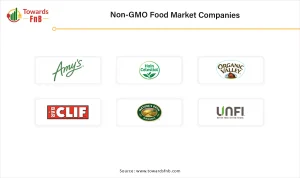
In-Depth Company Profiles: The Market Leaders in 2025
Each profile covers company overview, recent moves (drawn from provided developments where available), competitive edge, and future outlook. Language reflects strategies without asserting unaudited claims.
1. Nestlé
- Overview: Global food leader scaling non-GMO across cereals, dairy, and convenient nutrition.
- Recent Moves: In March 2025, launched CEREGROW multigrain cereal with no refined sugar, formulated with 19 key ingredients supporting normal growth.
- Competitive Edge: R&D scale, pediatric nutrition expertise, and distribution that can mainstream non-GMO at price points families accept.
- Outlook: Expect deeper pushes into non-UPF, school-friendly formats, and fortified SKUs blending whole grains with clear, kid-forward labeling.
2. Amy’s Kitchen
- Overview: Pioneer of organic, vegetarian, and non-GMO ready meals and snacks.
- Recent Moves: In September 2024, expanded into frozen breakfast (burritos, wraps, entrées) to meet convenience demand without sacrificing standards.
- Competitive Edge: Culinary credibility in freezer aisles; strong brand trust with ingredient-conscious shoppers.
- Outlook: Look for portion-controlled formats, kids’ SKUs, and channel-specific assortments that anchor premium convenience.
3. Organic Valley
- Overview: Farmer-owned cooperative focused on organic dairy with non-GMO feed alignment.
- Recent Moves: In January 2024, extended fluid milk portfolio with Organic Valley® Family First™, adding DHA Omega-3 and 12 essential nutrients.
- Competitive Edge: Farm-to-fridge transparency and cooperative governance that resonates with values-led buyers.
- Outlook: Continued growth in fortified organic dairy, lactose-adapted options, and pack sizes tailored to school and foodservice.
4. Hain Celestial
- Overview: Multi-brand better-for-you platform across snacks, teas, and pantry staples.
- Recent Moves: Focused on SKU rationalization and cleaner recipes to tighten non-GMO and minimal processing claims across hero brands.
- Competitive Edge: Breadth across center store categories and retailer partnerships for non-GMO resets.
- Outlook: Expect portfolio simplification and targeted innovation where shopper elasticity supports premium non-GMO price points.
5. Clif Bar & Company
- Overview: Performance and everyday energy bars with a long non-GMO stance.
- Recent Moves: Expanded family- and lunchbox-friendly formats while reinforcing oat-forward, recognizable ingredients.
- Competitive Edge: Strong equity among active households and outdoor communities; institutional presence for school and team sports.
- Outlook: Protein-plus whole-grain bars with clearer non-UPF cues and value packs for club formats.
6. Nature’s Path Foods
- Overview: Organic breakfast leader known for non-GMO cereals and granolas.
- Recent Moves: Line refreshes highlighting whole grains, lower sugar variants, and child-friendly flavors.
- Competitive Edge: Deep authority in clean breakfast; recyclable packaging initiatives reinforce values.
- Outlook: Growth via family multipacks, international expansion, and collaborations with non-UPF-aligned retailers.
7. United Natural Foods (UNFI)
- Overview: Major natural/organic distributor enabling non-GMO scale across retail.
- Recent Moves: Assortment curation and supply-chain services that help grocers expand non-GMO sets faster.
- Competitive Edge: Network breadth, data-driven category management, and last-mile reliability.
- Outlook: As specialty stores grow fastest, UNFI stands to benefit from brand discovery and regional rollouts.
8. McDonald’s
- Overview: Global QSR with significant supply-chain influence.
- Recent Moves: Ongoing evaluation of sourcing standards, consumer transparency, and menu innovations tailored to local preferences.
- Competitive Edge: Scale, price accessibility, and kitchen throughput; when standards shift, suppliers follow.
- Outlook: Expect selective non-GMO pilots in supply-constrained categories and continued emphasis on clear nutrition communication.
9. Pernod Ricard SA
- Overview: Premium beverages player engaging with agricultural inputs and consumer transparency trends.
- Recent Moves: Portfolio stewardship and ingredient clarity initiatives where category-appropriate.
- Competitive Edge: Brand equity and hospitality partnerships that can educate around agriculture and provenance.
- Outlook: Opportunity in non-GMO narratives for mixers/adjacent categories and experiential retail.
Invest in Our Premium Strategic Solution: https://www.towardsfnb.com/price/5557
10. Del Monte
- Overview: Household name in produce and shelf-stable fruits/vegetables.
- Recent Moves: Packaging updates and sourcing transparency to align with non-GMO and minimal processing expectations.
- Competitive Edge: Year-round availability and pricing balance for family households.
- Outlook: More fruit-first snacks, school-compliant servings, and cold-chain innovations that preserve quality with cleaner labels.
Why Competition Is Intensifying
- Certification stack becomes a moat.
Non-GMO verification, organic alignment, and the emergence of non-UPF seals shift advantage to brands with rigorous QA and supply visibility. - Farming tech and formats evolve.
Hydroponics and vertical farming support consistent non-GMO supply with less environmental variability. Brands that lock in these sources mitigate contamination risks and weather shocks. - Price pressure meets premium proof.
Private label pushes down price; brands must prove taste, nutrition, and sourcing to defend share. Family packs and club formats will test unit economics. - Meat & poultry surge.
As consumers scrutinize feed and husbandry, non-GMO feed claims become a growth engine but require tighter, costlier supply-chain controls. - Retail resets, fast learning cycles.
Hypermarkets reflow shelf sets to cluster non-GMO and non-UPF alternatives. Specialty stores accelerate discovery, forcing rapid iteration in pack size, flavors, and claims.
What’s Next (2025-2030 Outlook)
1) Non-GMO + Non-UPF becomes the household baseline.
Expect dual-badged products to gain endcap prominence, especially in breakfast, kids’ snacks, and dairy.
2) Traceability goes shopper-facing.
QR codes and digital passports will show farm, feed, and processing in seconds, building confidence and loyalty.
3) Regenerative and biodiversity premiums.
Brands that demonstrate pollinator protection, soil health, and water stewardship will command a values-driven premium especially in Europe.
4) Ingredient simplification at scale.
Shorter labels, fewer emulsifiers, and recognizable grains/legumes will power center-store turnarounds.
5) Food-as-function, but minimally processed.
Protein-plus whole grains, gut-friendly fibers, and micronutrient fortification will grow designed to avoid ultra-processing while delivering targeted benefits.
6) Risk management hardens supply.
Contracts that lock non-GMO seed, segregated storage, and contamination testing will become standard for cereals and animal feed supply chains.
Future Outlook
What It Means for Buyers, Investors, and Industry Leaders:
For buyers (retail, foodservice, and formulators): Make non-GMO + non-UPF your default spec in high-rotation categories (breakfast, dairy, snacks). Choose partners who can prove provenance, certify consistently, and deliver at scale.
For investors: A 9.32% CAGR category with multi-decade tailwinds in health and sustainability. Favor platforms that own traceable supply, certification discipline, and distribution leverage.
For industry leaders: The winners will pair simple, delicious recipes with auditable supply chains, readable labels, and clear education at shelf and screen.
Become a Valued Research Partner with Us – Schedule a meeting: https://www.towardsfnb.com/schedule-meeting
Feel Free to Get in Touch with Us for Orders or Any Questions at: sales@towardsfnb.com
Unlock expert insights, custom research, and premium support with the FnB Market Pulse Annual Membership. For USD 495/month (billed annually), get full access to exclusive F&B market data and personalized guidance. It’s your strategic edge in the food and beverage industry: https://www.towardsfnb.com/get-an-annual-membership
About Us
FnB Market Pulse is a global consulting firm specializing in the food and beverage industry, providing innovative solutions and expert guidance to elevate businesses. With an in-depth understanding of the dynamic F&B sector, we deliver customized market analysis and strategic insights. Our team of seasoned professionals is committed to empowering clients with the knowledge needed to make informed decisions, ensuring they stay ahead of market trends. Partner with us as we redefine success in the rapidly evolving food and beverage landscape, and together, we’ll navigate this transformative journey.