
The duck meat market enters 2025 with USD 3.40 billion in value, on track to accelerate toward USD 5.89 billion by 2034 at a steady 6.3% CAGR. That alone makes it a category that investors and buyers can no longer overlook—but 2025 matters for a bigger reason: this is the transition year where duck shifts from a niche, regional protein to a globally traded, premium, high-value meat supported by sustainability, culinary innovation, and stronger supply-chain investments.
Around the world, chefs are spotlighting duck on menus, consumers are seeking nutrient-rich proteins, and major producers are strengthening both traditional and alternative (lab-grown) duck offerings. For buyers and investors alike, this year marks a strategic pivot: market leaders are redefining farming, processing, branding, and distribution—and those moves will determine who dominates the next decade.
Key Takeaways for 2025
-
Demand for premium and gourmet proteins is accelerating, pushing duck further into mainstream consumption beyond Asia.
-
Fresh duck continues to dominate, but processed and ready-to-cook duck products grow fastest, reflecting lifestyle-driven convenience.
-
Sustainability becomes a core differentiator, not a side narrative buyers increasingly seek traceability and low-impact farming.
-
Asia Pacific maintains its lead, but North America emerges as the fastest-growing region through culinary adoption and shifts to high-protein diets.
-
Innovation from lab-grown duck to nutrient-enhanced genetics is expanding the competitive field.
Want to Explore More? Get a Free Sample Report:
https://www.towardsfnb.com/download-sample/5672
The 2025 Buyer Playbook: What Really Drives Decisions Now
Whether in retail, foodservice, or procurement, buyers in 2025 make decisions based on five dominant factors:
1. Provenance & Sustainability
Consumers want to know where the duck comes from, how it was raised, and whether it aligns with eco-conscious values. Free-range and organic models increasingly command premium pricing.
2. Culinary Versatility
Buyers prioritize cuts, flavor profiles, fat distribution, and cooking adaptability. Duck now competes directly with premium chicken products and often outperforms in flavor-driven cuisines.
1. Convenience Formats
Ready-to-cook duck breasts, pre-seasoned confit, and frozen portions are booming—particularly where home cooking culture merges with gourmet aspirations.
4. Supply Chain Reliability
Duck production is more sensitive than chicken or turkey, so buyers choose suppliers who show consistency, disease management, and dependable logistics.
5. Pricing Stability
With feed costs, climate effects, and seasonal variation impacting ducks disproportionately, buyers gravitate toward companies capable of hedging fluctuations.
In short: 2025 buyers choose suppliers who offer transparency, reliability, innovation, and culinary relevance not just price.
In-Depth Company Profiles: The 10 Major Halal Food Players in 2025
Below are deep, insight-rich profiles covering company overview, recent moves, competitive edge, and future outlook.
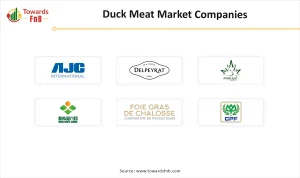
1. AJC International, Inc. (US)
- Overview: AJC is one of the largest global suppliers of frozen protein products, including duck. With distribution spanning 140+ countries, it plays a critical role in global duck meat logistics.
- Recent Moves: AJC expanded cold-chain capacity in 2024–2025, improving ability to move premium duck cuts into emerging markets in Africa and South America.
- Competitive Edge: A global trading network that can pivot quickly across regions—crucial in a market vulnerable to supply fluctuations.
- Future Outlook: Expect AJC to pursue more sourcing partnerships in Southeast Asia to stabilize long-term supply while enhancing private-label export solutions.
2. Delpeyrat SAS (France)
- Overview: A premium European brand renowned for duck foie gras, magret, and charcuterie. Delpeyrat’s heritage approach attracts high-end retailers and chefs.
- Recent Moves: The company has invested in artisanal processing and traceable farming, strengthening its position within Europe’s gourmet segment.
- Competitive Edge: Brand prestige and French culinary credibility—Delpeyrat sets standards for premium duck quality.
- Future Outlook: Growth will come from tourism-driven retail and premium e-commerce boxes aimed at global consumers seeking French gastronomy.
3. Maple Leaf Farms, Inc. (US)
- Overview: The leading US duck producer, responsible for ~50% of US production. Known for White Pekin duck, the most widely consumed duck breed in America.
- Recent Moves: The company expanded ready-to-cook product lines and strengthened sustainable farming commitments with zero-waste processing initiatives.
- Competitive Edge: Strong farmer partnerships, brand recognition, and a dominant domestic presence.
- Future Outlook: Expect aggressive entry into value-added duck products for supermarkets, including low-sodium, sous-vide, and chef-curated lines.
4. Pepe’s Ducks Ltd (Australia)
- Overview: Australia’s largest duck producer with a strong presence in retail and foodservice.
- Recent Moves: Invested heavily in hatchery tech and genetics to produce consistent, tender meat suitable for both Asian and Western cuisines.
- Competitive Edge: Exceptional breed consistency and animal welfare transparency.
- Future Outlook: Likely to grow export partnerships in Southeast Asia, where demand for Australian duck continues to rise.
5. Shandong New Hope Liuhe Group Ltd. (China)
- Overview: A major force in Asia’s poultry landscape, with duck farming integrated into its broader livestock and feed empire.
- Recent Moves: Massive automation efforts in farming and slaughtering; expansion of value-added duck snacks and ready meals for China’s convenience foods market.
- Competitive Edge: Scale, integrated feed operations, and unmatched influence across Chinese retail.
- Future Outlook: As China consumes most of the world’s duck, New Hope will push deeper into high-tech farming and branded product lines.
6. Charoen Pokphand Foods (Thailand)
- Overview: A multinational protein powerhouse with a growing footprint in duck meat, especially in processed and export-ready segments.
- Recent Moves: Upgraded export-oriented processing facilities focused on EU and Middle East certifications.
- Competitive Edge: Vertical integration from feed to farming to global logistics—creates exceptional cost and quality control.
- Future Outlook: CP Foods is poised to dominate processed and halal-certified duck exports.
7. Luv-a-Duck (Australia)
- Overview: A heritage Australian producer known for gourmet duck products and strong branding.
- Recent Moves: Launched new marinades and ready-to-heat duck meals catered to busy consumers.
- Competitive Edge: Brand warmth and premium positioning supported by strong marketing.
- Future Outlook: Likely to expand retail-ready meal kits and expand digitally through Australian e-commerce platforms.
8. TCH Group (US)
- Overview: A diversified US protein supplier with expanding capabilities in duck products for foodservice.
- Recent Moves: Introduced innovative supply chain software to help restaurant buyers forecast duck demand more accurately.
- Competitive Edge: Tech-forward distribution and strong B2B relationships.
- Future Outlook: Expect TCH to penetrate mid-tier restaurant chains with customized duck cuts and portion-controlled SKUs.
9. COOPERATIVE FOIE GRAS DE CHALOSSE (France)
- Overview: A cooperative specializing in foie gras and high-end duck products from the Landes region.
- Recent Moves: Expanded sustainability certifications that reassure European buyers of ethical production.
- Competitive Edge: Artisan-level production rooted in tradition.
- Future Outlook: Foie gras alternatives and specialty duck-derived products will be key revenue drivers as regulations evolve.
10. Lu Canard (Mexico)
- Overview: A rising player in Latin America that focuses on premium duck breeds for gourmet retail and foodservice.
- Recent Moves: Expanded local breeding programs and partnered with chefs to promote duck within modern Mexican cuisine.
- Competitive Edge: Agility and growing recognition within a region increasingly curious about duck-based dishes.
- Future Outlook: Poised to become the dominant Latin American duck brand by 2030 with export potential into North America.
Invest in Our Premium Strategic Solution: https://www.towardsfnb.com/checkout/5672
Why Competition Is Intensifying
Several pressures elevate competitive dynamics in 2025:
1. Demand Outpaces Traditional Capacity
Duck farming is more complex than chicken; companies scaling efficiently gain major advantage.
2. Premiumization Creates Margin Opportunities
Brands able to produce high-grade duck command strong pricing power—leading to fierce innovation.
3. Rise of Lab-Grown Duck
Companies like Integriculture and Memphis Meats challenge traditional producers, drawing investor attention.
4. Geographic Expansion
North America, Middle East, and Southeast Asia are opening new lanes for export-focused producers.
5. E-Commerce & DTC
Digital platforms allow niche brands to compete directly with long-standing giants.
What’s Next (2025-2030 Outlook)
The decade ahead will reshape the global duck landscape in five big ways:
1. High-Tech Farming Becomes Standard
Genetic optimization, climate-resilient housing, and automated feeding will elevate output and consistency.
2. Lab-Grown Duck Gains Foodservice Trials
By 2030, cultured duck liver products could sit alongside traditional foie gras in premium restaurants.
3. Value-Added Products Overtake Raw Duck
Globally, consumers will shift toward marinated, pre-cooked, frozen, and ready-to-eat duck formats.
4. Asia Will Remain the Powerhouse
China’s consumer growth and regional culinary traditions will ensure its continued global dominance.
5. Sustainability Will Define Market Leaders
Low-emission systems, water efficiency, traceability, and humane farming become non-negotiable buyer criteria.
Final Takeaway
The global duck meat market is entering an unprecedented growth phase driven by shifting diets, rising incomes, culinary curiosity, and sustainability expectations. For buyers, this means greater choice and higher quality. For investors, it signals a strong decade for alternative proteins, premium meats, and vertically integrated farming. For industry leaders, 2025 is the year to differentiate or be left behind.
Become a Valued Research Partner with Us – Schedule a meeting: https://www.towardsfnb.com/schedule-meeting
Feel Free to Get in Touch with Us for Orders or Any Questions at: sales@towardsfnb.com
Unlock expert insights, custom research, and premium support with the FnB Market Pulse Annual Membership. For USD 495/month (billed annually), get full access to exclusive F&B market data and personalized guidance. It’s your strategic edge in the food and beverage industry: https://www.towardsfnb.com/get-an-annual-membership
About Us
FnB Market Pulse is a global consulting firm specializing in the food and beverage industry, providing innovative solutions and expert guidance to elevate businesses. With an in-depth understanding of the dynamic F&B sector, we deliver customized market analysis and strategic insights. Our team of seasoned professionals is committed to empowering clients with the knowledge needed to make informed decisions, ensuring they stay ahead of market trends. Partner with us as we redefine success in the rapidly evolving food and beverage landscape, and together, we’ll navigate this transformative journey.