
The global date palm market is entering a defining moment in 2025. With a projected market value of USD 9.84 billion in 2025, and an anticipated climb to USD 13.53 billion by 2034, the sector is not just growing it’s evolving. Like ancient oases transforming into modern supply‑chains, date palms are moving from tradition and culture into mainstream global food, beverage, health, and nutraceutical markets. This year marks a tipping point as demand shifts, supply chains modernize, and consumers worldwide increasingly prize dates for both nutrition and versatility.
As more people embrace plant‑based diets, functional foods, and clean-label nutrition, dates are emerging as a natural sweetener, a rich source of micronutrients, and a culturally resonant superfood. 2025 is the year stakeholders growers, processors, exporters, food companies must adapt or risk being left behind.
Key Takeaways for 2025
- Rising global demand + health trends = boom for dates: The growing awareness of dates’ nutritional benefits, coupled with demand for healthy sweeteners and functional foods, is powering market growth.
- Product diversification is accelerating: Beyond whole and dried dates, segments such as date syrup, chopped dates, pastes, and nutraceutical derivatives are growing fastest.
- Date palm cultivation is spreading geographically: While the Middle East and Africa remain dominant producers, regions such as Asia‑Pacific and non‑traditional growers like India are expanding rapidly thanks to biotech and tissue‑culture innovations.
- Value‑added processing and branded dates are gaining share: Leading companies are investing in processing, packaging, export infrastructure, and brand-building shifting dates from commodity crop to premium, consumer‑facing product.
- Competition is intensifying across growers, exporters, and processors: As more players vie for market share from traditional Middle Eastern exporters to newcomers from India, Israel, and beyond margins are increasingly driven by quality, supply‑chain efficiency, and branding.
Want to Explore More? Get a Free Sample Report:
https://www.towardsfnb.com/download-sample/5674
2025 Buyer Playbook: What Drives Purchasing Decisions
What truly motivates buyers whether they’re food manufacturers, retailers, distributors, or end‑consumers has shifted. Here’s what works today:
- Health & wellness narrative: Buyers now look beyond taste and price. Dates are valued for fiber, natural sugars, antioxidants, and minerals and brands that highlight these benefits (e.g., as sugar substitutes, pre‑Ramadan staples, or health‑food ingredients) fare better.
- Form and convenience matter: Whole dates remain popular, but chopped dates, pitted dates, syrups, pastes, and snack‑ready formats are increasingly preferred for convenience or ingredient use.
- Supply‑chain reliability & traceability: Consistent quality and supply especially during peak demand periods like Ramadan drives sourcing decisions. Suppliers with integrated farms, processing, and export capabilities get priority.
- Sustainability and certification credentials: As global markets demand food safety, quality standards, and ethical sourcing, firms with good agricultural practices, sustainable packaging, and certifications win more business.
- Value‑added & branding premium: Bulk commodity dates are giving way to branded, value‑added products (stuffed dates, syrups, gift boxes, healthy snacks). Buyers increasingly prefer established brands they trust.
Company Profiles: The Players Redefining the 2025 Trail Mixes Market
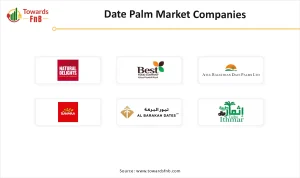
Here is a closer look at ten leading companies (or cooperatives) in the global date palm sector. Each represents a different strategy from traditional produce to high‑tech plantation, from bulk export to branded consumer products.
Natural Delights
- Overview: Founded by the Bard Valley Date Growers in the southwestern U.S., Natural Delights has grown from family‑run date groves into the number-one Medjool date brand in North America.
- Recent Moves: Natural Delights relaunched in 2025 with revamped supply‑chain transparency, sustainability‑focused packaging, and its annual Harvest Tour for retailers and media a savvy move to boost brand love and loyalty.
- Competitive Edge: Their strength lies in controlling the full supply chain from farms in Bard Valley’s ideal microclimate, through date harvesting, sorting, packing, and global distribution. Their sustainability commitments (drip irrigation, recycled packaging) resonate with conscious consumers.
- Outlook: As demand for clean-label, naturally sweet snacks grows globally, Natural Delights is well-positioned to expand its export footprint beyond North America perhaps into Europe, UAE, and health-food markets across Asia.
Atul Rajasthan Date Palms Ltd (ARDP)
- Overview: Based in Jodhpur, Rajasthan, ARDP is India’s first and largest manufacturer of tissue‑culture raised date palm plants. Launched through a public–private partnership between Atul Ltd and the Rajasthan Horticulture Development Society, the firm aims to reduce India’s heavy dependence on imported dates.
- Recent Moves: ARDP continues to propagate true‑to‑type date palms using technology licensed from the United Arab Emirates University’s Date Palm Research & Development Center. Their 2023-24 annual report emphasizes innovation, environmental sustainability, and an ambition to make India self-sufficient in date cultivation.
- Competitive Edge: By introducing tissue‑culture technology and arid-zone agriculture practices, ARDP enables date cultivation in Indian deserts — a major shift for a country that imports ~38% of the world’s dates.
- Outlook: As India’s climate-smart farming agenda and support for horticulture grow, ARDP could lead a domestic date‑palm revolution. Over the next 5–10 years, Indian-grown dates may start competing with imports in regional markets.
Emirates Dates (UAE)
- Overview: Established in 1989, Emirates Dates runs its own date palm plantations in Al Ain and Ras Al Khaimah, alongside a packing and export operation out of Abu Dhabi. It offers a wide range of date products from whole dates to date paste, syrup, and even seedlings.
- Recent Moves: Emirates Dates continues to expand its export footprint and participates in major international food fairs (e.g., 2024’s ADIFE in Abu Dhabi) to showcase its broad product portfolio.
- Competitive Edge: The company’s strength lies in vertical integration controlling plantations, processing, packaging, and exporting. With a production capacity claimed at around 700 tons, and decades of experience exporting to Europe, Asia, and beyond, Emirates Dates commands a solid presence across export markets.
- Outlook: As countries like India, Malaysia, and nations in Asia-Pacific import more dates especially value-added and processed forms Emirates Dates may leverage its export-ready infrastructure and broad product range to capture growing demand.
Al Barakah Dates Factory (UAE)
- Overview: A leading processor and exporter, Al Barakah Dates operates what is claimed as the world’s largest privately-owned dates factory located in Dubai Industrial City.
- Recent Moves: In February 2023, Al Barakah announced a joint venture with India-based Candor Foods Pvt Ltd to drive Indian market expansion, leveraging favorable conditions created by the new UAE‑India CEPA trade agreement.
- Competitive Edge: Its massive processing capacity (tens of thousands of tonnes), export to over 85 countries, advanced logistics and supply chain reach, and ability to supply both bulk raw material and value‑added date products give Al Barakah a distinct advantage — especially in B2B and industrial supply.
- Outlook: With the new joint‑venture foothold in India and global demand rising, Al Barakah could become a major dates ingredient supplier — not just whole-fruit providers for food companies, snack makers, and nutraceutical producers worldwide.
Hadiklaim Date Growers Cooperative Ltd (Israel)
- Overview: Founded in 1982, Hadiklaim is Israel’s largest date producer/exporter. The cooperative, owned by growers, leads globally in the Medjool date variety exporting under brand names such as “King Solomon” and “Jordan River.”
- Recent Moves: In recent years Hadiklaim has undergone management changes and rebranded itself, actively participating in global trade fairs (e.g., Fruit Logistica) to expand exports to Europe, South America, and Asia. They reportedly ship about 20,000 tons of dates and date products annually, with roughly half being Medjool variety.
- Competitive Edge: The cooperative model owned by growers ensures quality control and cost‑efficiency. Hadiklaim emphasizes certifications (organic, BRC, global G.A.P.) and invests in packaging, cooling houses, and export-ready infrastructure.
- Outlook: As demand for premium Medjool dates rises in Europe, North America, and Asia, Hadiklaim is well-positioned to capture value especially via exports and private-label deals.
Bayara (UAE, regional distributor)
- Overview: Bayara (established around 1992) is a regional powerhouse in nuts, dried fruits, spices including dates. It sources dates from Saudi Arabia, UAE, Jordan, and Tunisia, and offers plain, stuffed, chocolate-coated dates, pastes, syrups, etc.
- Recent Moves: Bayara has expanded its “Dates & Dried Fruits” line with multiple product formats (vacuum‑packs, syrups, coated dates), appealing to both retail consumers and gift markets especially around festive seasons.
- Competitive Edge: Bayara’s strength lies in branding, packaging, and distribution — especially in the Gulf and Middle Eastern retail markets. Their diversified product mix (snacks, sweets, pantry staples) helps them reach consumers seeking convenience and flavor.
- Outlook: Bayara is likely to capitalize on rising demand for festive date gifts and bulk retail consumption. As Middle Eastern expat populations grow globally, Bayara’s branded dates may see increased overseas demand.
Invest in Our Premium Strategic Solution: https://www.towardsfnb.com/checkout/5674
Why Competition Is Intensifying
1. Rising Global Demand Not Just in Traditional Markets
Demand for dates is no longer confined to the Middle East and North Africa. Health-conscious consumers worldwide are embracing dates as natural sweeteners, energy foods, and nutritious snacks. The expanding imports into Asia, Europe, and even North America are prompting more producers from India to Israel to the UAE to scale up.
2. Product Innovation & Value-Addition
Date syrup, date paste, stuffed or chocolate‑coated dates, chopped dates, date-based snacks these value‑added formats expand the market far beyond raw fruit. As more companies invest in processing and packaging, competition shifts from raw commodity to branded, consumer‑friendly products.
3. Diversification of Geographies and Producers
With firms like ARDP enabling date cultivation in India, and cooperatives like Hadiklaim in Israel tapping Mediterranean / non‑traditional climate zones, date production is spreading. This dilutes historical supply dominance of Gulf countries and creates new competitive fronts.
4. Supply-Chain Control & Branding as Differentiators
Today’s winners are those that control plantations, processing, packaging, logistics, and export enabling quality, traceability, and reliability. Branded companies that can tell a story (heritage Medjools, sustainable farming, premium gift boxes) capture more value than raw exporters.
5. Trade Agreements & Export Dynamics
Trade deals such as the UAE‑India CEPA are reshaping export and import flows. Companies like Al Barakah are already exploiting such policy shifts to tap into massive markets like India.
What’s Next: 2025-2030 Outlook
Looking ahead, the date palm market is likely to follow several converging trends:
- Explosion of value-added products: Expect to see more date‑based syrups, natural sweeteners, date‑seed oil, protein bars, snacks, functional foods and nutraceuticals. Dates may begin competing with honey, molasses, sugar, and other natural sweeteners.
- Geographic decentralization of cultivation: With tissue culture and climate‑smart agriculture, more non‑traditional regions India, parts of South Asia, even arid zones in Africa or Australia will start commercial date farming. That may diversify supply and reduce price volatility.
- Sustainability & certification standards will define premium segment: Consumers and buyers will favor producers with water‑efficient farming, organic practices, fair labor, and transparent supply chains. Those without such credentials risk commoditization.
- M&A, joint ventures, and consolidation: As margins thin in bulk exports, expect consolidations, joint ventures (like Al Barakah–Candor) and vertical integration across supply chain (farm → processing → retail).
- Rise in export to emerging markets: Countries like India, Southeast Asia, Africa where demand for healthy sweeteners and functional foods is growing will drive next wave of date consumption.
Future Outlook
The date palm industry in 2025 is no longer about farms in oases or traditional trade routes. It’s a dynamic global ecosystem of growers in deserts and new geographies, of processors and exporters, of brands marketing dates as healthful, versatile foods, and of consumers rediscovering a fruit steeped in cultural history.
For anyone who buys, invests in, or produces dates this is a defining moment. Those who move fast, build robust supply chains, innovate across product formats, and tell credible stories of quality and sustainability they’re the ones who will shape the next decade of growth in the global date palm market.
Become a Valued Research Partner with Us – Schedule a meeting: https://www.towardsfnb.com/schedule-meeting
Feel Free to Get in Touch with Us for Orders or Any Questions at: sales@towardsfnb.com
Unlock expert insights, custom research, and premium support with the FnB Market Pulse Annual Membership. For USD 495/month (billed annually), get full access to exclusive F&B market data and personalized guidance. It’s your strategic edge in the food and beverage industry: https://www.towardsfnb.com/get-an-annual-membership
About Us
FnB Market Pulse is a global consulting firm specializing in the food and beverage industry, providing innovative solutions and expert guidance to elevate businesses. With an in-depth understanding of the dynamic F&B sector, we deliver customized market analysis and strategic insights. Our team of seasoned professionals is committed to empowering clients with the knowledge needed to make informed decisions, ensuring they stay ahead of market trends. Partner with us as we redefine success in the rapidly evolving food and beverage landscape, and together, we’ll navigate this transformative journey.