
The amaranth color market may look niche at first glance, but in 2025, it sits at the crossroads of three powerful forces: the global rise of processed foods, the relentless demand for visual appeal, and widening regulatory divergence across regions. Valued at USD 61.60 million in 2025 and on track to nearly USD 99 million by 2034, this market is no longer just about a red dye it’s about cost control, scale, compliance, and strategic flexibility.
Why does 2025 matter so much? Because this is the year when buyers, especially in Asia-Pacific and the Middle East, are locking in long-term supply strategies, while manufacturers face intensifying pressure from clean-label trends, digital distribution, and expanding cosmetic applications. The decisions made now will shape who wins this market over the next decade.
Key Takeaways for 2025
- Asia Pacific sets the pace, accounting for roughly 45% of global revenue, driven by packaged food growth and flexible regulations.
- Synthetic amaranth still dominates, but clean-label blends are gaining momentum in premium and regulated markets.
- Powdered formats lead today, yet liquid amaranth is becoming the go-to choice for small-scale and specialty users.
- Cosmetics and personal care are the fastest-growing applications, benefiting from fewer regulatory hurdles than food.
- Competition is shifting from price-only to capability-driven, with formulation expertise and compliance becoming key differentiators.
Want to Explore More? Get a Free Sample Report:
https://www.towardsfnb.com/download-sample/5760
The 2025 Buyer Playbook: What Really Drives Purchase Decisions
In 2025, buyers no longer choose amaranth color based on price alone. Decision-making now revolves around five core factors:
- Regulatory Fit by Region
Buyers actively segment their portfolios. Synthetic amaranth flows into Asia, the Middle East, Africa, and parts of Latin America, while clean-label or natural-identical alternatives serve Europe and North America. - Format Flexibility
Large food processors favor powdered amaranth for its shelf life and transport efficiency. Smaller bakeries, beverage startups, and cosmetic brands increasingly prefer liquid formats for ease of use and precision. - Supply Reliability at Scale
Bulk buyers want suppliers who can deliver consistent color strength across batches. Any variability risks brand inconsistency. - Application-Specific Performance
Water-soluble amaranth dominates beverages and sauces, while oil-soluble variants gain traction in cosmetics, dairy fats, and personal care formulations. - Customization and Technical Support
Buyers increasingly value suppliers who help them tweak formulations to meet local compliance rules without sacrificing appearance.
In-Depth Company Profiles: The Market Leaders in 2025
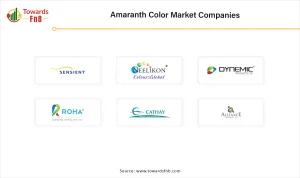
Sensient Technologies
- Overview: A global leader in colors and flavor systems.
- Recent Moves: Continued expansion of regional formulation labs in Asia.
- Competitive Edge: Deep regulatory expertise and application-specific solutions.
- Future Outlook: Positioned to bridge synthetic and clean-label portfolios seamlessly.
Neelikon Food Colors & Chemicals
- Overview: One of India’s most influential food color manufacturers.
- Recent Moves: Strengthened export footprint across Asia and Africa.
- Competitive Edge: Cost efficiency paired with FSSAI-compliant formulations.
- Future Outlook: Likely to benefit from India’s expanding processed food sector.
Dynemic Products Ltd.
- Overview: A diversified color and pigment specialist.
- Recent Moves: Investment in cosmetic-grade dye capabilities.
- Competitive Edge: Strong technical customization for non-food applications.
- Future Outlook: Well-positioned for cosmetic and personal care growth.
Roha Dyechem Pvt. Ltd.
- Overview: A long-established name in food colors and ingredients.
- Recent Moves: Expanded clean-label blend offerings.
- Competitive Edge: Global compliance experience.
- Future Outlook: Balancing synthetic scale with premium alternatives.
Cathay Biotech Inc.
- Overview: Known for biotech-driven ingredient solutions.
- Recent Moves: Focus on sustainable fermentation platforms.
- Competitive Edge: Innovation-led differentiation.
- Future Outlook: Potential pivot toward natural-identical color systems.
Alliance Organics LLP & Chromatech Incorporated
- Overview: Mid-sized players serving niche formulation needs.
- Competitive Edge: Agility and customer-specific customization.
- Future Outlook: Likely acquisition targets as consolidation accelerates.
Kolorjet Chemicals, Matrix Pharma Chem, Sun Food Tech, Food Ingredients India
- Overview: Regional specialists with strong domestic distribution.
- Competitive Edge: Speed-to-market and local regulatory knowledge.
- Future Outlook: Growth tied closely to regional consumption trends.
Global Chemicals Ltd., Koel Colours, Vinayak Ingredients, Neochem Technologies
- Overview: Volume-driven suppliers serving mass-market buyers.
- Competitive Edge: Competitive pricing and bulk supply.
- Future Outlook: Pressure to upgrade compliance and documentation.
TCI America, BioconColors, Pylam Products, Aakash Chemicals, Arlex Chemi
- Overview: Diverse portfolios with global reach.
- Competitive Edge: Broad application coverage.
- Future Outlook: Strategic positioning around specialty and pharma-grade dyes.
Invest in Our Premium Strategic Solution: https://www.towardsfnb.com/checkout/5760
Why Competition Is Intensifying Now
Competition is heating up because the market is no longer expanding evenly. Growth clusters in cosmetics, clean-label alternatives, and digitally enabled distribution, forcing suppliers to adapt or risk irrelevance. Regulatory bans in North America and tighter scrutiny in Europe are pushing companies to innovate, while Asia-Pacific and the Middle East reward speed, volume, and affordability.
At the same time, online B2B platforms are lowering entry barriers, enabling smaller brands to source directly and bypass traditional distributors.
What’s Next: 2025–2030 Outlook
Looking ahead, three trends will define the amaranth color market:
-
Hybrid portfolios will dominate, combining synthetic efficiency with clean-label optics.
-
Cosmetics will emerge as a growth engine, particularly in APAC and MEA.
-
Formulation science will matter more than volume, as buyers demand stability across applications and climates.
By 2030, successful suppliers will be those who treat amaranth not as a commodity, but as a strategic ingredient tailored to region, regulation, and end use.
Final Takeaway
In 2025, the amaranth color market rewards clarity and foresight. Buyers who align sourcing with regional regulations gain resilience. Investors who back formulation-driven players capture long-term value. Industry leaders who balance cost, compliance, and customization will shape the next phase of growth.
Amaranth color may be small in size but in strategy, it’s becoming a big deal.
Become a Valued Research Partner with Us – Schedule a meeting: https://www.towardsfnb.com/schedule-meeting
Feel Free to Get in Touch with Us for Orders or Any Questions at: sales@towardsfnb.com
Unlock expert insights, custom research, and premium support with the FnB Market Pulse Annual Membership. For USD 495/month (billed annually), get full access to exclusive F&B market data and personalized guidance. It’s your strategic edge in the food and beverage industry: https://www.towardsfnb.com/get-an-annual-membership
About Us
FnB Market Pulse is a global consulting firm specializing in the food and beverage industry, providing innovative solutions and expert guidance to elevate businesses. With an in-depth understanding of the dynamic F&B sector, we deliver customized market analysis and strategic insights. Our team of seasoned professionals is committed to empowering clients with the knowledge needed to make informed decisions, ensuring they stay ahead of market trends. Partner with us as we redefine success in the rapidly evolving food and beverage landscape, and together, we’ll navigate this transformative journey.
and more pressure to curate. For investors, the category offers stable growth with pockets of high-margin innovation. For leaders, the future belongs to those who modernize fast, understand flavor-driven emotions, and stay agile across retail and digital landscapes.