
The global alternative protein ingredients market is poised at an inflection point in 2025. With a valuation of USD 22.98 billion in 2024 and projected to rise to USD 26.24 billion in 2025, the stage is set for transformative growth. Over the period to 2034 it is expected to soar to USD 86.70 billion, at a CAGR of 14.2%.
Why 2025 matters: this is the year when many of the underlying technologies, supply-chains and regulatory frameworks begin to mature plant-based proteins are mainstreaming, microbial and fermentation-derived proteins are scaling, and consumer interest in nutritious, sustainable protein is stronger than ever. In short, the alternative protein ingredients market is stepping out of experimentation and into industrialised execution and that makes 2025 a pivotal moment.
Key Takeaways for 2025
- North America remains the dominant region (41 % share in 2024) thanks to strong funding, partnerships and industrial scale-up.
- Plant-based proteins hold the largest product share (70 % in 2024) but microbe-/fermentation-based proteins are the fastest growing (CAGR 24.2 %).
- Applications in animal feed and milk/dairy-alternatives are emerging fast: animal feed had 13 % share in 2024; dairy/milk-alternatives segment is expected to record the fastest growth in the coming years.
- Market competition is intensifying both large ingredient players and agile newcomers are pushing innovation, scale and cost-efficiencies.
- For buyers, investors and industry leaders, now is the time to evaluate not just ingredient pricing, but sourcing, sustainability credentials, techno-functional performance and regulatory readiness.
Want to Explore More? Get a Free Sample Report:
https://www.towardsfnb.com/download-sample/5639
2025 Buyer Playbook: What Really Drives Purchase Decisions & Deals
For companies buying alternative protein ingredients (whether food manufacturers, dairy-alternative brands or feed companies), decision-making in 2025 is centred on several key themes:
- Sensory & functional parity: Taste, texture and mouth-feel are no longer bonus features; they are table stakes. Ingredients must perform like animal-derived proteins in real applications.
- Clean label and nutritional credentials: Consumers increasingly demand minimal-ingredient lists, high protein, low saturated fat, allergen-friendly options and non-GMO. Ingredients that speak to these drivers win contracts.
- Sustainability & supply-chain security: Buyers are looking for sourcing transparency, lower environmental footprint (water, land, feed) and scalability of production. Ingredients that support climate resilience are preferred.
- Cost and scalability: While innovation is important, large-scale commercial viability is now critical. Buyers expect cost-competitive alternatives and reliable supply.
- Regulatory & geographic readiness: Especially in North America, Europe and APAC, being pre-aligned with regulatory pathways (novel-food, fermentation approvals) and regional growth is a differentiator.
- Partnership & ecosystem orientation: Deals increasingly involve co-development, joint scale-up, ingredient + formulation collaborations. Buyers prefer suppliers who act as ecosystem partners rather than commoditised vendors.
- Thus, in 2025 the focus shifts from “Does it work in the lab?” to “Can I deploy this at scale, commercially, and win with it in market?” For buyers, the checklist extends to cost-of-goods, supply chain agility, sustainability credentials and formulation support.
In-Depth Company Profiles: The Market Leaders in 2025
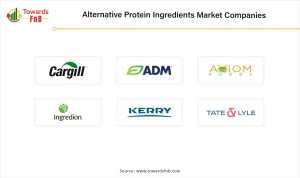
Here are deeper profiles of ten major companies active in the alternative-protein ingredients space. Each covers overview, recent moves, competitive edge and future outlook.
1) Impossible Foods
- Overview: A front-runner in meat analogues now building a deeper ingredient library beyond the burger.
- Recent Moves: Broader retail and foodservice placements, plus line extensions that improve protein density and cooking behavior.
- Competitive Edge: A/B-tested flavor chemistry and fat systems that deliver convincing Maillard notes and juiciness; strong storytelling for mainstream consumers.
- Future Outlook: Expect more ingredient licensing and co-development with manufacturers needing drop-in flavor/fat systems for hybrid (animal + alt) products.
2) Beyond Meat
- Overview: Category-making brand with a growing focus on cleaner labels and better macros.
- Recent Moves: Iterations that lower sodium and refine binders; more value-engineered SKUs for club/value channels.
- Competitive Edge: Global brand recognition and a proven frozen and fresh playbook for mass retail.
- Future Outlook: Strategic shift toward cost-down formulations and hybrid formats that keep taste high and price low enough for weekly baskets.
3) Cargill
- Overview: One of the world’s largest agrifood suppliers powering plant proteins, fermentation inputs, texturizers, and fats/oils.
- Recent Moves: Collaboration with multiple alt-protein innovators (plant and cell-based) and scaling of pea and soy ecosystems; solution selling that bundles proteins with fibers, oils, and emulsifiers.
- Competitive Edge: Global supply security, deep technical centers, and the ability to support multi-region rollouts with consistent specs.
- Future Outlook: More personalized nutrition systems (protein + fiber + fat) tailored to beverages, dairy, and ready meals, with sustainability data integrated into customer RFPs.
4) ADM (Archer-Daniels-Midland)
- Overview: A human-nutrition heavyweight with advanced plant proteins, flavor modulation, and microbiome-adjacent research.
- Recent Moves: Investments in fermentation partnerships and next-gen plant sources; toolkits that pair proteins with masking and savory enhancers.
- Competitive Edge: End-to-end capability proteins, flavor, color, lipid systems backed by global application labs.
- Future Outlook: Expect ADM to push system-level solutions for dairy alternatives and high-protein snacks, dialing in texture and lingering flavor issues that hold back repeat rates.
5) Ingredion
- Overview: A leader in starches, sweeteners, and plant proteins (notably pea and faba) with solid allergen management.
- Recent Moves: Expanded textured protein offerings for meat analogues and cleaner-label binding systems for bakery and plant-based meats.
- Competitive Edge: Strong cost-in-use proposition and a reputation for consistent particle size, solubility, and viscosity critical for RTD beverages and spoonables.
- Future Outlook: Deeper work on blend optimization (pea + faba + chickpea) to close amino acid gaps and improve mouthfeel with fewer additives.
6) Kerry Group
- Overview: Taste and nutrition specialist blending flavors, enzymes, and functional systems to make alt proteins delicious and manufacturable.
- Recent Moves: Talent development (e.g., flavor science scholarships) and expanded clean-label flavor systems designed for reduced-sugar, high-protein products.
- Competitive Edge: Culinary + science integration that solves off-notes, brings authentic regional profiles, and elevates texture without long labels.
- Future Outlook: Growth in dairy and beverage systems where taste fatigue kills repeat; more partnerships with fast-growing APAC brands.
7) Tate & Lyle PLC
- Overview: Global solutions player across sweetening, fiber, and texture—key to sugar reduction and calorie control in high-protein formulas.
- Recent Moves: New capacity for non-GMO soluble fibers to support sugar-reduced formulations without sacrificing body or mouthfeel.
- Competitive Edge: Ability to pair proteins with fibers (e.g., polydextrose/soluble fiber) and stabilizers, delivering label-friendly nutrition and sensory parity.
- Future Outlook: Expect more “protein + fiber” blueprints for RTDs, yogurts, and frozen desserts; stronger sustainability metrics packaged for retailer scorecards.
8) Roquette Frères
- Overview: French ingredient innovator with a strong plant-protein portfolio (notably pea) and pharma-grade processing discipline.
- Recent Moves: Expanded isolate and textured ranges; new grades targeting solubility for beverages and bite for HMMA.
- Competitive Edge: European regulatory fluency, robust allergen control, and reliable supply big pluses for global CPGs.
- Future Outlook: Push toward new legumes and fermentation-enabled proteins to diversify away from soy and manage future price volatility.
9) Meati Foods
- Overview: A fungi/mycelium pioneer producing whole-cut and ingredient-grade mycoproteins with a short, clean ingredient list.
- Recent Moves: Scaling production and building foodservice credibility with chef partnerships that showcase texture and nutrition density.
- Competitive Edge: Fiber-rich, complete-protein profile and naturally meaty texture—appealing for clean-label menus and premium retail.
- Future Outlook: Ingredient sales into hybrid meat and ready meals, where mycelium’s water-holding and structure deliver juiciness without long additives.
10) Shiok Meats
- Overview: APAC cultivated-protein innovator exploring seafood and complementary protein systems.
- Recent Moves: Progress on regulatory and pilot production fronts; collaboration with regional partners on hybrid products blending cultivated and plant/microbial inputs.
- Competitive Edge: Category whitespace in seafood analogues, strong APAC ecosystem ties, and a credible sustainability narrative.
- Future Outlook: As costs drop, expect ingredient-style offerings for seafood flavor/fat systems that upgrade plant bases, especially in Japan, Singapore, and coastal China.
Invest in Our Premium Strategic Solution: https://www.towardsfnb.com/checkout/5639
Why Competition Is Intensifying
- Volume growth meets cost pressure: As the market grows (CAGR 14.2% 2025-2034), ingredient buyers demand scale, lower cost and higher functionality. Suppliers must invest in scale-up and cost-competitive manufacturing.
- Technology convergence: New protein sources (microbe-, ferment-, mycelium-based) are moving from lab to pilot to commercial. Suppliers must differentiate through technology, not just commodity pulses.
- Brand and consumer shifts: Brands are pushing harder on taste, nutrition, clean-label, plant-plus & flexitarian consumers. Ingredient firms must keep up with evolving consumer demands which increases competition for supplier-attention.
- Regional expansion: Asia-Pacific, Europe, Latin America are investing heavily in alternative proteins; ingredient suppliers must regionalise supply-chains, engage local regulation and partner with local brands this fragments the supplier field.
- Consolidation & partnerships: Ingredient firms increasingly partner with start-ups, co-develop formulations, or acquire capabilities (e.g., Tate’s acquisition of chickpea-protein firm). This raises the competitive bar for firms that cannot invest similarly.
What’s Next (2025-2030 Outlook)
- Scale & Cost convergence: By 2030 we can expect many alternative protein ingredients to approach cost-parity (or near parity) with traditional animal-derived proteins, especially in categories like snack bars, dairy alternatives and animal feed.
- Emerging sources become mainstream: Microbial fermentation, mycelium/fungal proteins and insect proteins will gain commercial traction. This will open new supplier-categories and intensify competition beyond plant-only.
- Regional diversification: While North America dominates now, Asia-Pacific will accelerate fastest. Ingredient suppliers will locate production closer to demand (e.g., India, Southeast Asia), and buyers will prioritise regional supply chains.
- Integration up the value chain: Ingredient firms will increasingly offer full formulation suites (protein + fibre + texture + health claims) rather than simple isolates. Buyer expectation will shift to “solutions” not just ingredients.
- Sustainability metrics matter more: By 2030, ESG credentials (water use, land use, GHG emissions) of ingredient supply-chains will be standard KPIs in procurement. Suppliers who cannot demonstrate credible sustainability will lose access.
- Regulatory & novel-food frameworks evolve: In markets like Europe, Asia and Latin America, regulatory clearance for new proteins (fermentation, cultivated) will mature, opening up bigger pools of volume and thus supplier opportunity.
Future Outlook
For buyers, 2025 is the year to shift from speculative sourcing to commercial-scale implementation choose suppliers who can deliver taste, cost, sustainability and regulatory readiness at scale.
For investors, the upward trajectory of alternative protein ingredients is clear but the winners will be those with scale, differentiation and a path to cost-parity (not simply hype).
For industry leaders, this market is not about “plant vs animal” anymore it’s about protein as a system: sourcing, functionality, consumer preference, sustainability and supply-chain agility. If the ingredient you choose falters in any of these dimensions, you risk being out-paced.
2025 marks the transition of the alternative protein ingredients market from promise to performance. The question now is which companies will scale, which formulations will win, and which buyers will align early to unlock competitive advantage. The time to engage strategically is now.
Become a Valued Research Partner with Us – Schedule a meeting: https://www.towardsfnb.com/schedule-meeting
Feel Free to Get in Touch with Us for Orders or Any Questions at: sales@towardsfnb.com
Unlock expert insights, custom research, and premium support with the FnB Market Pulse Annual Membership. For USD 495/month (billed annually), get full access to exclusive F&B market data and personalized guidance. It’s your strategic edge in the food and beverage industry: https://www.towardsfnb.com/get-an-annual-membership
About Us
FnB Market Pulse is a global consulting firm specializing in the food and beverage industry, providing innovative solutions and expert guidance to elevate businesses. With an in-depth understanding of the dynamic F&B sector, we deliver customized market analysis and strategic insights. Our team of seasoned professionals is committed to empowering clients with the knowledge needed to make informed decisions, ensuring they stay ahead of market trends. Partner with us as we redefine success in the rapidly evolving food and beverage landscape, and together, we’ll navigate this transformative journey.