
In 2025, the 3D food printing market is poised to revolutionize the way we think about food production. With a projected market size of USD 535.08 million, expected to grow at an astonishing CAGR of 34.3%, the industry is quickly gaining momentum. From personalized nutrition to sustainable food production, 3D food printing is not just a passing trend it’s shaping the future of the food industry. But what makes 2025 such a pivotal year for this market, and why should stakeholders take note?
Key Takeaways for 2025
- Market Growth: The 3D food printing market is expected to grow from USD 535.08 million in 2025 to USD 7,605.04 million by 2034, expanding at a CAGR of 34.3%.
- Technological Advancements: The rise in AI and robotics integration will enhance the precision, efficiency, and scalability of 3D food printers.
- Customization is Key: Consumer demand for personalized food products will drive innovation, particularly in confectionery and meat products.
- Sustainability Focus: 3D food printing offers sustainable alternatives, reducing food waste and reliance on traditional farming methods.
- Regional Growth: While North America remains the dominant market, Asia-Pacific is expected to witness the highest growth due to increasing disposable incomes and urbanization.
Want to Explore More? Get a Free Sample Report:
https://www.towardsfnb.com/download-sample/5600
The 2025 Buyer Playbook: What Drives Purchase Decisions?
- As the 3D food printing market matures, understanding the factors that drive buyer decisions will be key for manufacturers, restaurants, and tech developers. What are the primary considerations when investing in food printing technologies?
- Customization and Personalization: As consumer preferences evolve, the ability to create customized food products with unique shapes, flavors, and nutritional content is becoming a major selling point. This is especially important in sectors like confectionery and specialized diets.
- Sustainability: With increasing awareness of environmental issues, food producers are looking for ways to reduce waste and improve sustainability. 3D food printing offers an eco-friendly alternative to traditional food production by utilizing plant-based proteins and reducing food waste.
- Cost Efficiency: Although the upfront costs of 3D food printers can be high, buyers are increasingly focused on long-term savings through automation, reduced labor costs, and less food waste.
- Quality Control: The ability to consistently produce high-quality food products with precise control over ingredients and texture is crucial in industries such as foodservice and packaged goods.
- Ease of Integration: As food companies move towards digital manufacturing, they seek 3D food printing solutions that can easily integrate into their existing production lines and supply chains.
In-Depth Company Profiles: The Market Leaders in 2025
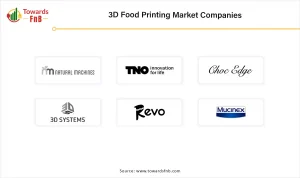
1. BeeHex
- Company Overview: BeeHex is a pioneering company in the food printing space, known for its high-precision 3D food printers used primarily in the bakery and confectionery industries.
- Recent Moves: In 2024, BeeHex expanded its product range with the 3D Dessert Decorator, aimed at bakeries and small-scale food businesses looking for intricate designs.
- Competitive Edge: BeeHex’s strength lies in its user-friendly, customizable designs that cater to the evolving needs of the food service industry, especially in high-demand markets like bakery and quick-service restaurants (QSRs).
- Future Outlook: With increasing demand for personalized food products, BeeHex is set to further enhance its capabilities in creating highly customizable food options for both small and large-scale food businesses.
2. byFlow B.V.
- Company Overview: Based in the Netherlands, byFlow B.V. specializes in 3D food printing solutions, with a focus on both commercial and residential applications.
- Recent Moves: byFlow introduced the Focus 3D Printer, designed for flexibility and portability, making it suitable for both professional kitchens and home use.
- Competitive Edge: The company’s ability to adapt its products for different consumer segments, from home users to commercial kitchens, gives it a competitive edge in the rapidly expanding market.
- Future Outlook: byFlow is focused on further enhancing the versatility and affordability of its 3D printers, which could appeal to a wider audience, from personal users to large-scale food manufacturers.
3. Natural Machines
- Company Overview: Natural Machines, the creators of the Foodini, focuses on printing with fresh ingredients to produce gourmet-quality meals.
- Recent Moves: In 2024, Natural Machines introduced enhancements to the Foodini printer, focusing on improving user experience and customization capabilities.
- Competitive Edge: Foodini’s capability to print with fresh ingredients—such as vegetables, meats, and herbs sets it apart from competitors primarily focused on processed materials.
- Future Outlook: As the demand for fresh, personalized meals grows, Natural Machines is well-positioned to lead the market with its unique approach to fresh food printing.
4. Systems And Materials Research Corporation (SMRC)
- Company Overview: SMRC is a leader in food printing technology, specializing in large-scale, extrusion-based 3D printers for industrial food production.
- Recent Moves: SMRC partnered with major food manufacturers to incorporate 3D printing into their production lines, focusing on meat and plant-based protein products.
- Competitive Edge: Their ability to scale 3D food printing for industrial production gives them an edge in meeting the growing demand for mass-customized, high-volume food manufacturing.
- Future Outlook: As the market for alternative proteins and plant-based foods grows, SMRC’s technology is poised to drive innovation in food production at a larger scale.
5. Revo Foods
- Company Overview: Revo Foods is an Austrian food-tech company that has taken a pioneering role in the development of plant-based seafood using 3D printing technology.
- Recent Moves: In 2024, Revo Foods launched the world’s first 3D-printed vegan salmon, a breakthrough in plant-based protein alternatives.
- Competitive Edge: Revo’s ability to replicate the texture, flavor, and nutritional profile of seafood without using animals gives it a significant competitive edge in the plant-based food market.
- Future Outlook: As demand for sustainable and cruelty-free food options increases, Revo is positioned to lead the plant-based food revolution with its 3D printing innovations.
6. mycusini® (Print2Taste GmbH)
- Overview: Based in Germany, mycusini® offers a compact 3D chocolate printer designed for home use.
- Recent Developments: The company has expanded its product line to include various edible materials, enhancing the versatility of its printers.
- Competitive Edge: mycusini® stands out for its user-friendly design and affordability, making 3D food printing accessible to a broader audience.
- Future Outlook: The company aims to further innovate in the home-use segment, focusing on expanding its range of printable materials and designs.
7. FELIXprinters
- Overview: A Dutch company specializing in professional-grade 3D printers, FELIXprinters has ventured into the food printing sector with its FELIX Food series.
- Recent Developments: The launch of the FELIX Food 1.6 Single Head printer has broadened its offerings in the food printing market.
shop.felixprinters.com - Competitive Edge: FELIXprinters is known for its high-quality, customizable printers that cater to both professional and educational sectors.
- Future Outlook: The company plans to expand its presence in the food printing industry by developing more specialized printers and exploring new applications.
8. SavorEat
- Overview: An Israeli food-tech company, SavorEat has developed the Robot Chef, a 3D printing system that prints and cooks plant-based meat alternatives.
SavorEat - Recent Developments: SavorEat has partnered with Sodexo to deploy its technology in U.S. universities, marking a significant step in commercial adoption.
The Spoon - Competitive Edge: The Robot Chef offers on-demand customization and rapid cooking times, appealing to the growing demand for personalized plant-based options.
- Future Outlook: SavorEat aims to expand its market reach and continue innovating in the plant-based food sector.
9. 3D Food Srl
- Overview: Based in Italy, 3D Food Srl specializes in the development of 3D food printers and related technologies.
- Recent Developments: The company has been focusing on enhancing the precision and efficiency of its printing systems.
- Competitive Edge: 3D Food Srl’s expertise in food technology and engineering positions it well in the European market.
- Future Outlook: The company plans to expand its product offerings and explore new applications in the food industry.
10. Redefine Meat
- Overview: An Israeli startup, Redefine Meat focuses on producing 3D-printed plant-based meat alternatives that mimic the taste and texture of traditional meat.
Redefine Meat - Recent Developments: The company has secured significant funding to scale its production and expand its market presence.
3D Printing Industry - Competitive Edge: Redefine Meat’s technology enables the creation of whole cuts of plant-based meat, offering a unique product in the alternative protein market.
- Future Outlook: The company aims to become a leading player in the alt-meat sector by leveraging its innovative 3D printing technology.
Invest in Our Premium Strategic Solution: https://www.towardsfnb.com/checkout/5600
Why Competition Is Intensifying in the 3D Food Printing Market
The 3D food printing market is seeing heightened competition for several reasons:
- Technological Advancements: As printing technology becomes more advanced, food producers are seeking faster, more efficient solutions. This drives both innovation and competition in the sector.
- Consumer Demand for Personalization: With increasing consumer desire for customized food products, companies are racing to offer more adaptable and personalized food printing solutions.
- Sustainability Pressure: As sustainability becomes a priority, companies are pushing to develop solutions that reduce food waste and the environmental impact of food production.
- Investment and Partnerships: As more companies enter the market and larger food brands partner with 3D printing tech providers, competition is intensifying, driving innovation and lowering costs.
What’s Next: 2025-2030 Outlook
As we move from 2025 into 2030, the 3D food printing market is poised for significant expansion. Here are some key trends to watch:
- Sustainability and Eco-Friendly Practices: As governments and consumers demand more sustainable food production methods, 3D food printing will play a major role in reducing food waste and carbon footprints.
- Integration with AI and IoT: The integration of AI and IoT with food printing technology will enable better customization, efficiency, and predictive capabilities in food manufacturing processes.
- Expansion into Alternative Proteins: Plant-based and lab-grown proteins are expected to drive much of the innovation in 3D food printing, making it an essential technology for future food production.
- Government Initiatives: Governments are increasingly investing in 3D food printing for applications like personalized nutrition, disaster relief, and space exploration, opening new markets for this technology.
- Gourmet and Personalized Foods: As consumer interest in gourmet and personalized foods grows, 3D food printing will become a key tool for chefs and food innovators, enabling them to create unique culinary experiences.
Closing Takeaway
What This Means for Buyers, Investors, and Industry Leaders
- For buyers, 3D food printing offers the opportunity to create customized food products, improve production efficiency, and meet growing consumer demand for personalized, sustainable food options.
- For investors, the rapidly growing market, with its potential for massive returns, is a promising area to watch. Companies that can innovate and scale efficiently are likely to emerge as industry leaders.
- For industry leaders, staying ahead of technological advancements and addressing sustainability concerns will be crucial for success. Embracing 3D food printing will not only improve operational efficiency but also allow food companies to cater to a growing market that demands both personalization and sustainability.
Become a Valued Research Partner with Us – Schedule a meeting: https://www.towardsfnb.com/schedule-meeting
Feel Free to Get in Touch with Us for Orders or Any Questions at: sales@towardsfnb.com
Unlock expert insights, custom research, and premium support with the FnB Market Pulse Annual Membership. For USD 495/month (billed annually), get full access to exclusive F&B market data and personalized guidance. It’s your strategic edge in the food and beverage industry: https://www.towardsfnb.com/get-an-annual-membership
About Us
FnB Market Pulse is a global consulting firm specializing in the food and beverage industry, providing innovative solutions and expert guidance to elevate businesses. With an in-depth understanding of the dynamic F&B sector, we deliver customized market analysis and strategic insights. Our team of seasoned professionals is committed to empowering clients with the knowledge needed to make informed decisions, ensuring they stay ahead of market trends. Partner with us as we redefine success in the rapidly evolving food and beverage landscape, and together, we’ll navigate this transformative journey.